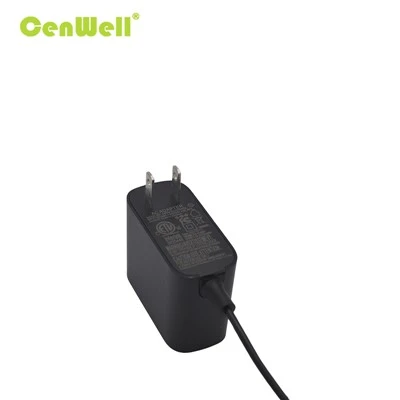
The working principle of the USB charger mainly includes the USB-PD communication protocol and the charging strategy of lithium-ion batteries.
The USB-PD communication protocol uses the AC-coupled FSK signal on VBUS for half-duplex communication to realize the charging process of the mobile phone and the charger. When the cable is connected, the SOP communication of the USB-PD protocol is carried out on the CC line (Type-C interface communication configuration channel) to select the power transmission specification. The SINK end asks the SOURCE end for the power configuration parameters that can be provided (such as 5V, 9V, 12V, etc.). The communication process includes:
The SINK end initiates the SOP (starting segment) to apply for the specification information that the SOURCE end can provide.
The SOURCE end replies with a list of specifications that can be provided.
The SINK end selects a voltage and current pair and sends a request.
The SOURCE end adapter accepts the request after internal decoding and conversion, adjusts the adapter output, and achieves a stable charging voltage and current.
The charging strategy of lithium-ion batteries requires special attention. Incorrect charging methods will shorten battery life and even cause safety problems. The charging process usually includes a pre-charge phase and a fast-charge phase:
Pre-charge phase: When the battery voltage is below a certain threshold, the charging current must be very small, so that the battery can accept high-current charging and release the undervoltage protection state of the battery protection circuit.
Fast-charge phase: When the battery voltage exceeds the pre-charge threshold, the charger enters the constant current (CC) mode and provides current to the battery according to a pre-defined constant current, usually between 0.5C and 1C. When the battery voltage reaches the rated voltage, the charger switches to the constant voltage (CV) mode, and the charging current gradually decreases to avoid overcharging.
The design of a USB charger needs to consider many factors, including cost, size, weight, charging time and power budget. After a USB device is plugged into a USB port, the device can enter a fully working state as quickly as possible. At the same time, the allowed battery charging time and power budget are also important considerations during design.